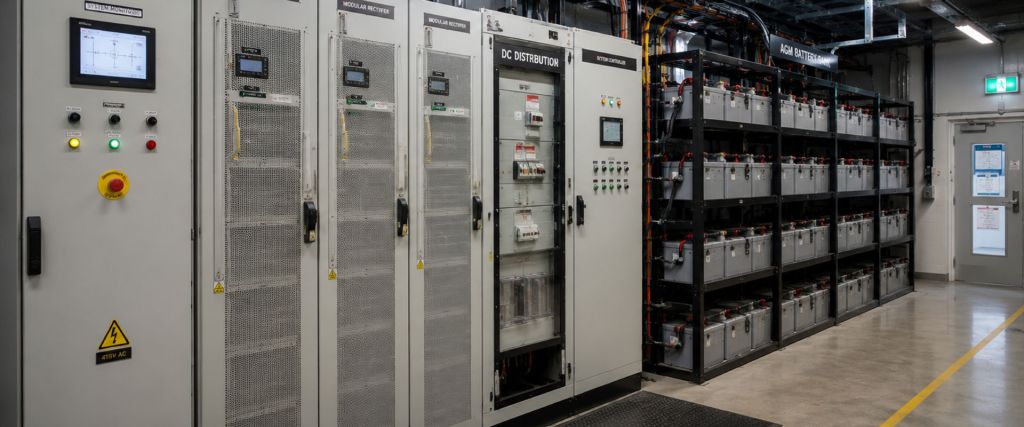
Effective Battery Ventilation Starts at the Design Stage
Battery ventilation is a critical part of designing safe, compliant and reliable battery systems for critical infrastructure. While batteries provide dependable standby power when primary supply is interrupted, designing a reliable system involves more than selecting the right battery capacity and chemistry.
Valve Regulated Lead Acid (VRLA) batteries can release hydrogen gas during normal operation and under fault conditions. Without adequate ventilation, hydrogen can accumulate within a battery room or enclosure, creating a potential safety risk. For engineers, EPCs and infrastructure operators, this makes battery ventilation an engineering consideration that should be addressed from the earliest stages of a project, not after equipment has been selected or installed.
Why Battery Ventilation Matters in Battery Rooms
VRLA batteries are designed to recombine gases internally during normal operation, but they are not completely gas-tight. Hydrogen can still be released, particularly during charging and under abnormal or fault conditions. Because hydrogen is highly flammable, battery rooms and enclosures need sufficient airflow to prevent gas from accumulating to unsafe concentrations.
Australian Standards provide requirements for the safe installation and ventilation of stationary battery systems. These requirements influence not only the battery installation itself, but also the design of the surrounding room, enclosure and ventilation system.
Good battery ventilation therefore protects more than the batteries. It supports the safety of personnel, surrounding equipment and the wider critical power system.
Battery Ventilation and Hydrogen Gas Risk
Hydrogen is colourless, odourless and highly flammable. In an enclosed environment, inadequate battery ventilation can allow released hydrogen to accumulate.
For this reason, ventilation design needs to consider how much hydrogen a battery installation may generate and how effectively that gas can be dispersed. This is particularly important in enclosed battery rooms, cabinets and other restricted spaces where natural airflow may be limited.
The objective is not simply to provide a vent or fan. It is to establish an appropriate ventilation strategy based on the characteristics of the battery system and its operating environment.
How Battery Ventilation Requirements Are Calculated
Battery ventilation requirements should be calculated for the specific installation rather than estimated or assumed. Factors including the number of battery cells and charging current influence the required ventilation rate, while the relevant Australian Standards provide a framework for determining the airflow required to safely disperse hydrogen generated by the battery system.
These calculations can then inform decisions around room dimensions, vent sizing, airflow paths and whether natural or mechanical ventilation is appropriate. Completing this work during battery system design gives engineers an opportunity to identify potential constraints before equipment is installed.
Natural Versus Mechanical Battery Ventilation
Depending on the installation, battery ventilation may be achieved through natural or mechanical means. Natural ventilation uses appropriately positioned openings to allow air movement and hydrogen dispersion without powered ventilation equipment, and where site conditions and room design allow it, this can provide a straightforward ventilation solution.
Mechanical ventilation may be required where natural airflow cannot provide the necessary ventilation rate or where the physical characteristics of the room or enclosure limit passive airflow. The appropriate approach depends on the battery system, required airflow and site conditions.
What matters is that the selected ventilation method is supported by the required engineering calculations and incorporated into the overall system design.
Room and Enclosure Planning for Battery Systems
Battery ventilation cannot be considered independently of the space in which the system will operate. Room dimensions, equipment layout, battery configuration, access requirements and airflow all interact.
A battery system that fits within the available floor area may still create design challenges if there is insufficient provision for ventilation, maintenance access or safe equipment clearances. This becomes particularly important in substations, telecommunications facilities, utilities and other infrastructure environments where plant room space can be constrained.
Considering the complete footprint early allows the battery system, charger, ventilation and surrounding infrastructure to be planned together.
Why Battery Ventilation Should Be Engineered Early
One of the most effective ways to reduce battery ventilation problems is to address them before the system specification is finalised. At the design stage, engineers can assess battery sizing, charging requirements, ventilation rates, available space and room configuration as part of the same engineering process.
If battery ventilation is addressed too late, the consequences can extend beyond adding a vent. Insufficient airflow or an unsuitable room configuration may require changes to equipment layout, enclosure design, ventilation infrastructure or other aspects of the project. In constrained environments, this can create unnecessary redesign, specification changes and additional project complexity.
Early consideration gives EPCs and design engineers greater certainty that the proposed battery system can be safely accommodated within the available space.
Compliance in Battery System Design
Compliance should be integrated into battery system design rather than treated as a final check before commissioning. For VRLA and lead acid battery installations, applicable Australian Standards provide requirements relating to battery installation, ventilation and safe operation.
Century Yuasa considers these requirements alongside battery sizing, charger selection, room design, installation and ongoing maintenance to develop integrated DC power systems for critical infrastructure. This whole-of-system approach helps ensure battery ventilation is not treated as an isolated requirement, but as part of the engineering required to support safe and reliable operation over the life of the asset.
Design Battery Ventilation Into the System From the Start
Effective battery ventilation begins well before installation. Understanding hydrogen gas risk, completing the appropriate ventilation calculations and allowing for airflow within the room or enclosure can help engineers identify potential issues early and avoid unnecessary redesign later in the project.
For asset owners and infrastructure operators, it also provides greater confidence that the battery system has been designed with safety, compliance and long-term operation in mind. At Century Yuasa, battery ventilation forms part of a broader engineering approach to critical power system design, helping ensure batteries, chargers, ventilation, room requirements and ongoing lifecycle considerations are assessed as an integrated system.
Plan for Battery Ventilation Before Installation
Safe and reliable battery systems begin with sound engineering and early consideration of the installation environment.
Discover how Century Yuasa supports critical infrastructure projects through battery system design, ventilation calculations and complete DC power system engineering.
Explore our DC power solutions or speak with our engineering team.
Technical resource: Download Century Yuasa’s Ensuring Compliance and Safety in Critical Power Systems whitepaper for further information on battery ventilation requirements and Australian Standards.