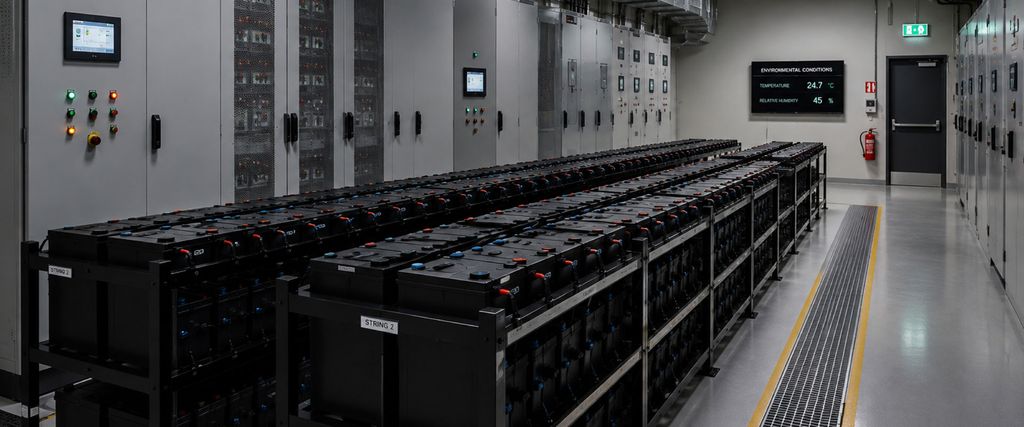
UXL Batteries Highlight Why Design Life Should Be Considered Across the Complete System
UXL batteries provide a useful example of why battery design life should be considered alongside the lifecycle of the wider critical power system. For asset owners, the question is not simply how long an individual battery or charger is designed to last, but how effectively the replacement cycles of major system components can be managed over the life of the asset.
Critical power systems may remain in service for decades. During that time, batteries, chargers and associated equipment will require maintenance and eventually replacement. When those lifecycle requirements are considered independently, asset owners can face multiple interventions, additional labour, equipment handling and disruption across the operating life of the system. Better alignment between battery and power system design life provides an opportunity to take a more coordinated approach.
Battery Design Life Needs to Be Read in Context
A headline design-life figure does not tell the complete story. For lead acid batteries, the temperature associated with the design-life specification is particularly important.
A battery described as having a 20-year design life at 20°C is not directly equivalent to a battery designed for 20 years at 25°C. As highlighted in Intelepower’s technical guidance, a 20-year design life at 20°C equates to approximately 13 years at 25°C. This distinction matters in Australian critical power applications, where Australian Standards mandate batteries designed around 25°C.
When assessing standby batteries, engineers and asset owners should therefore check the reference temperature associated with the stated design life rather than comparing the headline number alone. Two batteries may both be described as 20-year products while representing substantially different lifecycle expectations at the relevant operating temperature.
Why the 25°C Battery Design Life Matters
Temperature has a significant influence on battery ageing and expected service life, which makes the reference temperature more than a technical detail in a product specification. It directly affects how an asset owner can plan for future battery replacement.
If a battery’s stated design life is based on 20°C but the system is being designed around 25°C, using the headline figure for lifecycle forecasting can create an unrealistic expectation of how long the battery will remain in service. For long-term critical infrastructure, that difference can influence maintenance strategies, capital planning and the timing of future replacement programs.
Understanding the temperature basis of the battery specification provides a more meaningful foundation for whole-of-life planning.
Battery and Charger Design Life Should Be Considered Together
Batteries and chargers perform different functions, but they operate as part of the same DC power system. Their replacement cycles should therefore be considered together during system design and lifecycle planning.
If the battery requires replacement significantly earlier than the charger or wider system, the site may need multiple major interventions throughout the life of the asset. Each intervention can involve planning, site access, isolation, battery handling, specialist labour, testing and recommissioning. For geographically dispersed infrastructure, these requirements may also involve travel, contractor coordination and operational scheduling.
Better lifecycle alignment can reduce the number of times major system components need to be accessed and replaced independently.
Longer Battery Design Life Can Reduce Replacement Interventions
For asset owners, one of the potential benefits of longer-life standby batteries is the opportunity to reduce replacement frequency, particularly where the expected battery lifecycle can be more closely aligned with the charger or broader power system.
Fewer planned replacements can mean fewer occasions where batteries need to be removed, transported and installed, along with fewer associated testing and commissioning activities. The benefit becomes increasingly significant across infrastructure networks with large numbers of sites, where a replacement decision that appears relatively small at one installation can become a substantial lifecycle program when repeated across dozens or hundreds of assets.
Looking at replacement frequency across the complete asset base can therefore provide a more useful measure of value than considering individual battery purchase price alone.
Reduced Replacement Can Mean Reduced Labour and Handling
Battery replacement involves more than purchasing new equipment. Existing batteries need to be safely isolated and removed, while replacement batteries need to be transported to site, installed, connected, inspected and tested before the system is returned to normal operation.
Depending on the size and location of the installation, battery handling can also create logistical and access requirements that need careful planning. Reducing unnecessary replacement interventions can therefore reduce the labour and handling associated with maintaining the critical power system over its operating life.
For remote substations, telecommunications facilities and other difficult-to-access infrastructure, avoiding an additional replacement cycle can be particularly valuable.
UXL Batteries as a Lifecycle Planning Proof Point
Yuasa UXL GEN2 batteries provide a useful example of how battery technology can support longer-term lifecycle planning. UXL GEN2 is a long-life VRLA battery range designed for critical standby applications, with a 20-year design life at 25°C.
This allows the battery specification to be considered in the context of the expected lifecycle of chargers and other critical power system equipment. The value is not simply that the battery has a longer stated design life, but that longer-life battery technology may help align replacement intervals across the complete system and reduce the number of major interventions required throughout the asset lifecycle.
For asset owners, that turns battery selection into a lifecycle planning decision rather than simply an equipment procurement decision.
Lifecycle Alignment Can Simplify Long-Term Planning
Critical infrastructure operators often manage assets across multiple sites, with equipment installed at different times and operating under different conditions. Replacement forecasting across these networks can become complex.
Understanding the expected lifecycle of batteries, chargers and associated equipment allows asset owners to develop more structured replacement programs and anticipate future capital requirements. Where replacement intervals can be better aligned, planning can become simpler and maintenance and replacement work can be coordinated as part of a broader lifecycle strategy rather than treated as a series of individual end-of-life events.
This supports an evidence-based approach to replacement planning, where battery condition, operational performance, environmental influences and maintenance history are considered together rather than relying on age alone.
Whole-of-Life Value Goes Beyond Purchase Price
The lowest initial equipment cost does not necessarily represent the lowest whole-of-life cost. For critical power systems, asset owners also need to consider installation, maintenance, replacement frequency, labour, handling, site access and the operational requirements associated with each intervention.
A battery with a lower purchase price but a shorter effective lifecycle may require additional replacement activity over the operating life of the wider system. Conversely, equipment that supports longer replacement intervals may create value through reduced interventions and more predictable lifecycle planning.
The appropriate decision will depend on the application, operating environment and asset strategy. The important point is that battery selection should be evaluated within the lifecycle of the complete critical power system rather than on purchase price alone.
Align Critical Power System Lifecycles From the Beginning
Lifecycle planning is most effective when it begins during system design. Understanding battery and charger design life, checking the temperature basis of battery specifications and considering expected replacement intervals early allows asset owners to make more informed decisions about the long-term management of their critical power infrastructure.
At Intelepower, battery selection forms part of a complete system engineering approach that considers performance, design life, operating environment, maintenance requirements and long-term asset management together. UXL batteries can support this approach by providing a long-life VRLA option for critical standby applications where lifecycle certainty is an important consideration.
Plan for the Life of the Complete System
Battery design life should not be assessed as an isolated product specification. Aligning battery, charger and wider system lifecycles can help reduce replacement interventions, simplify long-term planning and provide asset owners with a clearer view of whole-of-life value.
Discover Yuasa UXL GEN2 batteries and Intelepower’s engineered DC power solutions, or speak with our engineering team about lifecycle planning for your critical power assets.